



Articles by Initial Letters
Női szerepek a magyar néphagyományban – III.
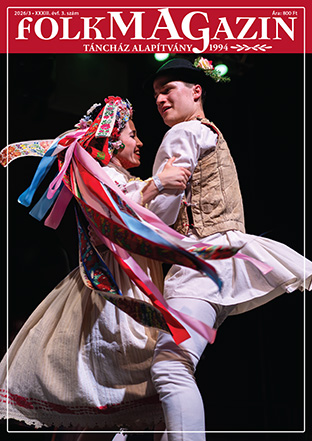

Ratkó Lujza: Woman’s Roles in Hungarian Folk Dance Tradition – part 3
This is part 3 of a lengthy Hungarian dance ethnography study originally published in a professional journal. This final section addresses the women’s role in Hungarian couple dances. 1) First she discusses situations when the women’s role is on equal standing with the men’s role. That is, in couple dances where the man and woman both dance freely without holding on to one another. In this case the woman’s dancing is different from the man’s. The goal of the man’s performance is to win over the woman and get her attention. The woman’s role is flirtatious, playfully luring, enticing the man sometimes trying to trick him. Examples from couple stick dances and couple jumping dances – ugrós – are provided. The second type is when the woman’s role is subordinate to the men’s. In traditional Hungarian couple dances the man’s role is to lead his partner, the woman must follow her partner, adjusting or conforming to his lead. In the couple dances, especially in those dances where the man and woman dance closer together, out of necessity, the dancers must adjust to one another. Traditionally the man takes the decisive role and leads the woman; a couple is made up of opposites who complete or complement one another. The forgatós turning dances of the Nyárad and Maros regions in Transylvania nicely demonstrate the man’s role of leading and moving – turning – the woman around his axis. The man dances in a very small space - he initiates the movement. In the summary the author revisits the karikázó or circle dances done by woman originally with a specific ritualistic function during lent. Then she briefly reminds us of the two kinds of woman’s roles in Hungarian couple dances. Bibliography and footnotes included. Published first in: Studies in Dance Research/ Tánctudományi Tanulmányok 2002-2003 pp 157-177 (2005)
This is part 3 of a lengthy Hungarian dance ethnography study originally published in a professional journal. This final section addresses the women’s role in Hungarian couple dances. 1) First she discusses situations when the women’s role is on equal standing with the men’s role. That is, in couple dances where the man and woman both dance freely without holding on to one another. In this case the woman’s dancing is different from the man’s. The goal of the man’s performance is to win over the woman and get her attention. The woman’s role is flirtatious, playfully luring, enticing the man sometimes trying to trick him. Examples from couple stick dances and couple jumping dances – ugrós – are provided. The second type is when the woman’s role is subordinate to the men’s. In traditional Hungarian couple dances the man’s role is to lead his partner, the woman must follow her partner, adjusting or conforming to his lead. In the couple dances, especially in those dances where the man and woman dance closer together, out of necessity, the dancers must adjust to one another. Traditionally the man takes the decisive role and leads the woman; a couple is made up of opposites who complete or complement one another. The forgatós turning dances of the Nyárad and Maros regions in Transylvania nicely demonstrate the man’s role of leading and moving – turning – the woman around his axis. The man dances in a very small space - he initiates the movement. In the summary the author revisits the karikázó or circle dances done by woman originally with a specific ritualistic function during lent. Then she briefly reminds us of the two kinds of woman’s roles in Hungarian couple dances. Bibliography and footnotes included. Published first in: Studies in Dance Research/ Tánctudományi Tanulmányok 2002-2003 pp 157-177 (2005)